
死亡笔记
NZ’s push for joint statement on China missile test falls flat amid growing Pacific Islands autonomy_我的网站

A |
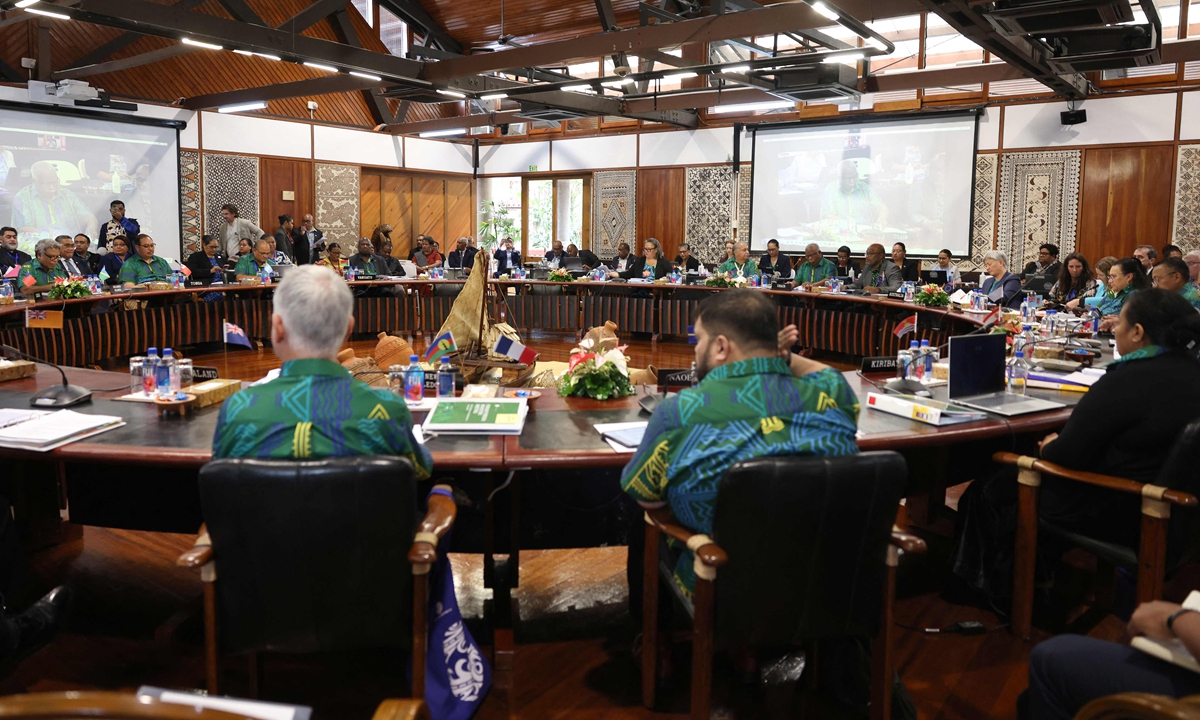
As foreign ministers and senior representatives from Pacific nations convened in Suva for the Pacific Islands Forum (PIF) to discuss key regional issues, New Zealand's foreign minister reportedly pushed to secure a joint statement condemning China's missile tests in July, however, his effort ultimately fell flat. A Chinese expert described the outcome as a clear rebuke to Canberra and Wellington's ingrained habit of speaking for the Pacific, saying the two countries must come to terms with a shifting reality: Pacific Island states are increasingly unwilling to let Australia and New Zealand dictate who their friends, foes and perceived security threats should be.
Pacific Island foreign ministers failed to agree on Friday to a joint response to China's missile launch in July, with further discussions expected at the Pacific leaders meeting at the end of August, said New Zealand Foreign Minister Winston Peters, according to Reuters.
According to a report from Radio New Zealand, there has not been a unanimous statement from Pacific nations about China's test-launch in July, and Peters said New Zealand had been pushing for one. Peters claimed that the Pacific missed an opportunity not to issue a joint statement soon after China's launch.
Australia's Foreign Minister Penny Wong said before the meeting that she hoped China took note of the "very clear response" already sent from the Pacific about the test, according to AFP.
Peters' push for a joint PIF statement on China's missile tests, together with Wong's remarks, are less about technical security concerns than an effort to turn their own anxieties about China into a regional agenda and pressure Beijing under the forum's collective banner. His description of Pacific Island countries' refusal to single out China as a "missed opportunity" also reveals little respect for their independent judgment, Chen Hong, director of the New Zealand Studies Centre, East China Normal University, told the Global Times.
The result is a clear rebuke to Canberra and Wellington's long-standing habit of arrogantly "speaking for" the Pacific, as island states are increasingly unwilling to let Australia and New Zealand decide who their friends, foes or security threats should be, said Chen Hong.
The Chinese People's Liberation Army Navy said on July 6 that one of its strategic nuclear submarines successfully launched a strategic missile toward relevant high seas of the Pacific Ocean, which landed precisely within the designated waters. China notified relevant countries in advance of the test launch, a move that demonstrates the openness and transparency of the Chinese armed forces, Chen Xi, a spokesperson for the Ministry of National Defense, said at a press conference on July 7.
Chen Hong also noted that Peters' recent China-related rhetoric has become increasingly populist and hawkish as elections approach in New Zealand. "Such an approach risks undermining New Zealand's long-standing reputation for pragmatic, independent, and rational diplomacy," Chen Hong said.
In July, during a parliamentary debate on New Zealand's Covid-19 pandemic response, Peters, who is also leader of the populist New Zealand First party, told a Chinese-born lawmaker to "go back to your own country" while mocking his English proficiency. His remarks drew wide criticism in New Zealand.
Yet Australia and New Zealand continued to amplify missile-related issues and great-power rivalry, pushing the "China threat" narrative to the center of the regional agenda while sidelining the priorities that matter most to Pacific Island nations, said Chinese analysts.
Chen Hong noted that for island states, the most urgent concerns are not geopolitical competition but everyday challenges: climate change, energy security, development financing, infrastructure and economic resilience. By shifting the focus from these concerns to strategic rivalry among major powers, Australia and New Zealand risk distorting the region's real priorities and undermining the aspirations of Pacific Island countries.
According to an introduction on the forum website, "The Forum's Pacific Vision is for a resilient region of peace, harmony, security, social inclusion and prosperity, so that all Pacific people can lead free, healthy, and productive lives."
At the opening of the meeting, Rick Houenipwela, foreign minister of the Solomon Islands and chair of the meeting, said that the Pacific's agenda must continue to be "conceived by the Pacific, shaped by the Pacific and only by the Pacific," according to Reuters.
Chen Hong said Pacific Island nations have made their position clear: differences with China do not mean signing up to the strategic agendas of Australia and New Zealand. A growing number of island countries refuse to be trapped in the black-and-white binary choice of siding with either China or the West.
If Canberra and Wellington keep pushing rhetoric beyond the regional consensus, they risk undermining the very institution they claim to support. The PIF's strength lies not in issuing confrontational statements, but in preserving Pacific unity. Turning that consensus into a tool for pressuring China would erode the forum's cohesion and weaken its central role in the region, said Chen Hong.
。 (ECNS) -- China firmly opposes illicit unilateral sanctions that have no basis in international law or the authorization of the UN Security Council, Foreign Ministry Spokesperson Lin Jian said Tuesday. He made the remarks after U.S. Treasury Secretary Scott Bessent on Monday laid out plans for the economic asphyxiation of Iran, expanding Washington's secondary sanction threats and warning of dire consequences for countries that do not join the campaign. Lin stressed that economic warfare and maximum pressure provide no solution. On the contrary, they only serve to fuel tensions and lead to risk spillover, which will disrupt the global economic and financial order, and harm the legitimate rights and interests of other countries. The spokesperson noted that the pressing task is to facilitate the de-escalation of the situation and return to dialogue and negotiation as soon as possible, adding that China will do everything necessary to firmly safeguard its rights and interests. (By Gong Weiwei)

 。
。Current article:http://cp5boj.pisezuibanzoukou.cyou/list_3033/0zd21yc.html
Published on:19:05:40
我的网站相关阅读
- 澳洲CPI全面超预期!澳元跳涨至6月以来高位,澳洲联储9月会出手吗?
- 托卡耶夫压倒性大胜,他干的第一件事,被解读为给普京“上眼药”,朔方瞭望,原创 托卡耶夫压倒性大胜,他干的第一件事,被解读为给普京“上眼药”
- 全新一代智己 L6 定档 8 月 28 日正式上市,新车预售权益价 21.99 万元起
- 中科曙光:即将发布推理相关存储新技术
- 伊朗反对周边国家参与美“经济战”:否则将被视为敌人
- 曲江文旅:2026年半年度净利润约681万元
- 两战狂胜49分!日本男篮29分大胜双杀韩国 八村轮休河村24+6
- 微信春节红包蛋面向世界:企业可定制专属封面
- 四川长虹:上半年净利润16.46亿元,同比增长228.62%
我的网站最新文章
- 慈善团体讲述购捐疫苗辛酸往事,民进党“挡疫苗内幕”引发岛内愤怒
- Dehradun News: साइबर ठगो के चंगुल में फंसे केवि के टीचर, शेयर में निवेश के नाम पर 20 लाख की ठगी
- 感恩回馈!学生三人票低至29.9元,这些人免费入园→
- 中东冲突推高能源价格 英国10月家庭能源成本将上涨
- Then Vs Now: Bollywood Child Artists Who Went On To Become Established Actors
- 全场0破发!郑钦文0比2完败泰国选手,本赛季6次“一轮游”
- 记者:加拉塔萨雷不想为莱奥支付4000万欧元以上转会费
- 《致命躯壳2》处决动作:把剑插头里当武器 还要被主角踹剑柄
- 長野久義氏が激白!「裸で寝てます」「ノーパン健康法っていうのがあるらしくて」
- 福建深远海养殖再升级 全产业链目标产值500亿元
- 科学家发现可能导致阿尔茨海默病的新蛋白质
- 冬奥冠军齐广璞:继续备战2026年冬奥会 希望更多年轻人爱上冰雪运动
- 特朗普称考虑将安大略湖更名为“美国湖”
我的网站随机推荐
- 拼多多单量下滑的几个原因
- Giant panda Jia Jia celebrates 14th birthday at Shanghai wildlife park
- 新加坡泡泡玛特盲盒抢疯了!插队、争吵,还叫来了警察
- 2025年618活动哪天买最便宜省钱优惠力度最大,淘宝京东618活动满减攻略及超级红包领取
- 宏胜集团人力资源部部长寇静被免职
- 2025年618和国补可以叠加吗?618从6月17日晚8点开始最便宜
- 燃油车大幅降价,刚买的车就贬值?买车用车避坑指南
- Colombia earthquake kills at least 111
- 售25.35万起/全新里程碑 小米YU7上市18小时锁单突破240000台
- 菲总统马科斯宣布因疫情导致的全国灾难状态延长至年底
- 2026玫瑰婚典七夕盛会19日启幕 77对有情人共赴一场浪漫之约
- Video: Wildfires in Northern Morocco Destroy More Than 6,000 Hectares of Forests
- 全新奥迪Q5L申报图 与上海车展首发车外观有不同 五代EA888发动机